
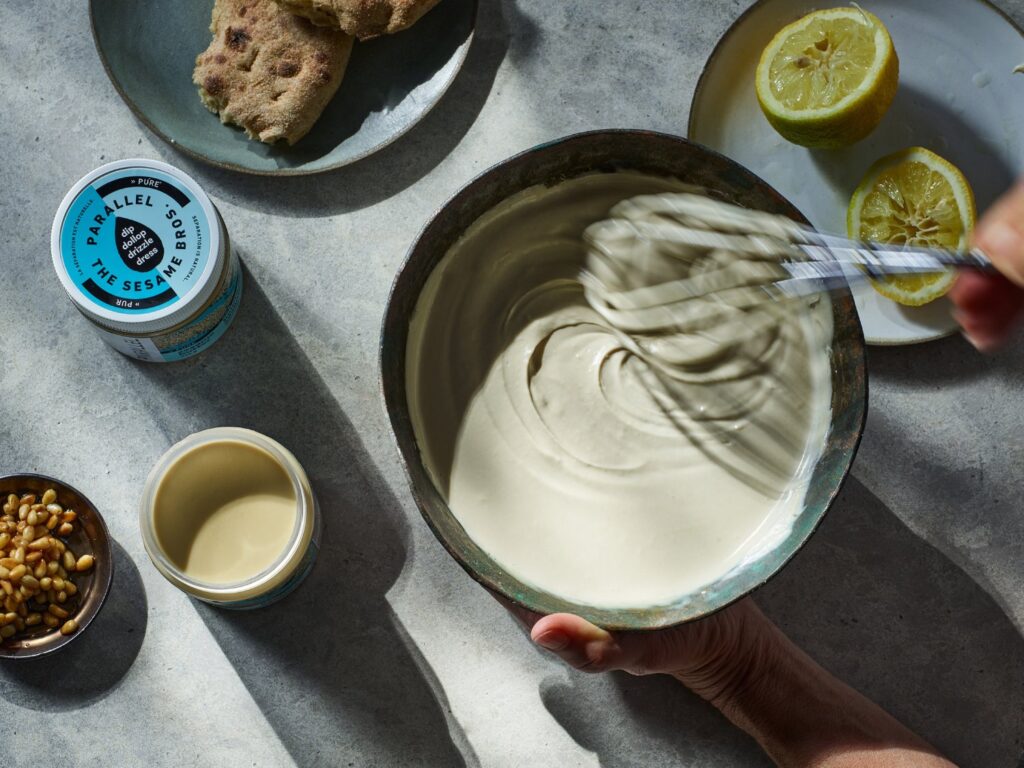
Most people reach for warm water when mixing tahini. It seems like the logical choice, something gentle enough to loosen the thick paste without shocking it. As it turns out, that instinct leads cooks in exactly the wrong direction. Cold water, sometimes even ice-cold, consistently produces a smoother, creamier, more satisfying result. The reason has nothing to do with tradition or taste preference. It comes down to physics.
What Is Actually Happening in the Bowl
When water meets tahini, the two do not simply blend together. What forms is an emulsion, a system in which tiny water droplets become suspended throughout the fat rather than separating from it. The stability and quality of that emulsion determines everything about the final texture.
The key factor is droplet size. When the droplets that form during mixing are small and uniform, the emulsion holds together reliably and the sauce feels smooth and consistent on the palate. When they are large or uneven, the structure is weaker and more likely to break down before mixing is complete.
Cold water gives those droplets the best chance of forming correctly. Lower temperatures slow molecular movement, which means the droplets have more time to settle into a fine, even distribution before the mixture destabilizes. Warm water does the opposite. It speeds things up in a way that works against the emulsion, producing larger, less uniform droplets and increasing the risk that the whole thing falls apart mid-stir.
The Reward You Can See
Getting the emulsion right does not just improve how tahini feels. It changes how it looks. Once the water droplets are properly distributed throughout the fat, they interact with light in a specific way, scattering it in all directions rather than allowing it to pass straight through. This is the same optical principle responsible for milk’s white appearance.
Raw tahini is a dull brownish-beige. Properly emulsified tahini turns noticeably lighter, almost pale and luminous by comparison. That color shift is not incidental. It is a reliable visual signal that the emulsion has formed correctly and that the texture will be everything it should be.
A Small Change, a Meaningful Difference
Switching from warm to cold water is one of the simplest adjustments a cook can make, and one of the most effective. It requires no additional ingredients, no special equipment, and no extra effort. The only thing that changes is the temperature of the water going into the bowl.
The result is a tahini sauce that is more stable, more consistent, and more pleasant to eat. Not bad for a trick that most recipe writers never think to mention.