
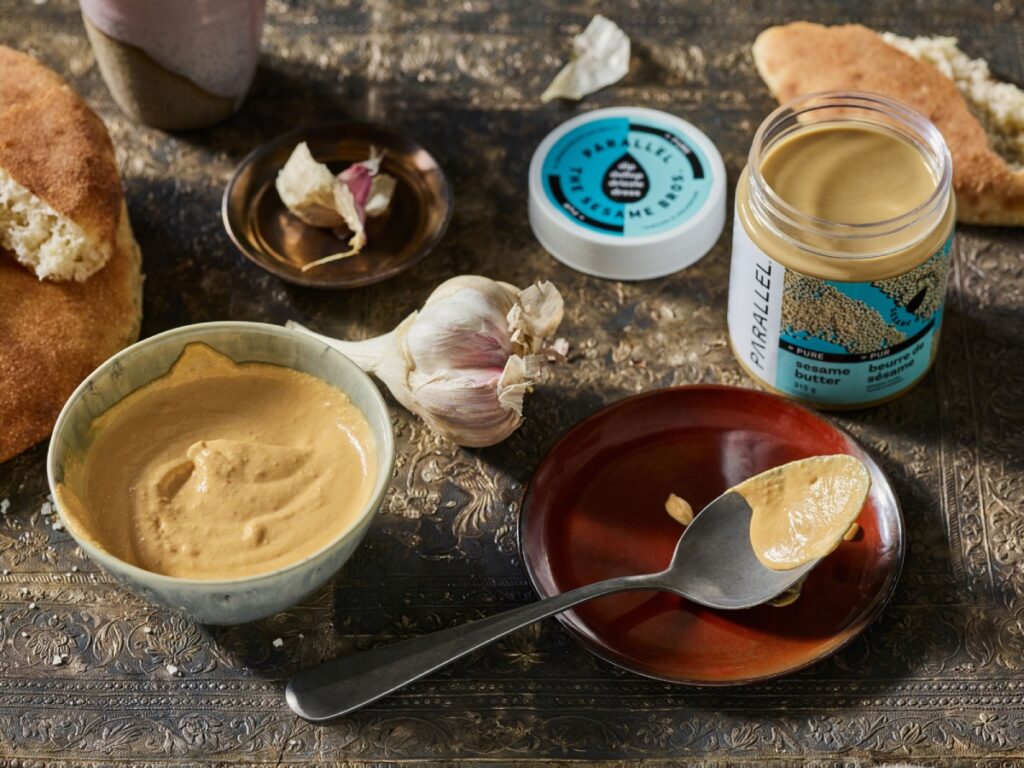
Every home cook who has worked with tahini has encountered that puzzling moment. A splash of water goes in, and rather than loosening the paste, it seizes up, turning stiff, dense, and grainy. It looks less like progress and more like a mistake. Yet with a bit more water and a continued stir, something shifts. The paste surrenders, opening into a silky, pale, pourable sauce. What exactly is going on inside that jar?
When Fat Runs the Show
To understand the transformation, it helps to think about what raw tahini actually is. Ground sesame seeds release their oils during milling, producing a paste where fat is the dominant, continuous phase. Everything else, proteins, carbohydrates, tiny solid particles, floats within that oily matrix.
When a small amount of water enters this environment, it does not dissolve or disperse freely. Oil and water have no interest in mixing. Instead, the proteins and carbohydrates in the paste begin greedily absorbing whatever moisture they can find.
Think of dry beach sand. Sprinkle a few drops of water on it and you do not get a puddle. You get a clump. The grains stick together, and the whole thing feels heavier and more resistant than before. Add enough water, though, and the sand loosens and flows. Tahini follows the same logic.
As those microscopic particles swell with absorbed water, friction between them increases sharply. At the same time, tiny water droplets begin dispersing through the fat, forming what chemists call an emulsion. The combined effect is a steep rise in viscosity, meaning the paste thickens noticeably before it has any intention of thinning.
Only once enough water has been incorporated and mixing has continued does the emulsion settle into a stable configuration. Resistance drops, droplets distribute evenly, and the tahini relaxes into the creamy, smooth consistency cooks are after.
More Than a Condiment
Tahini tends to be underestimated. It sits quietly on the shelf next to more glamorous ingredients, valued mostly as a background player in hummus or a drizzle over falafel. Scientifically, though, it is a remarkably instructive food.
The act of grinding sesame seeds does not merely crush them. It fundamentally reorganizes their structure, releasing oils that would otherwise stay locked inside and creating a material that behaves in ways the whole seeds never could. The thickening-then-thinning sequence that unfolds when water is added is not quirky or accidental. It is the same interplay of emulsification, particle hydration, and viscosity that governs how mayonnaise holds together, how ice cream achieves its texture, and how milk behaves in a glass.
The next time you watch tahini seize up at the first touch of water, then slowly relent and turn glossy and smooth, you are watching physics and food chemistry work in real time. It is a surprisingly elegant display for something made from nothing more than a pile of crushed sesame seeds.